
By Steven Zhang.
In 2021, transportation accounted for 27% of greenhouse gas emissions in the United States [1]. This is compared to only 19% in The Netherlands [2], or 15% in Japan [3]. A significant portion of this discrepancy can be attributed to urban planning policies in the United States. Studies have consistently shown an inverse trend between urban density and transportation energy use per capita [4]. In other words, the greater the population density of a city, the lower the per-capita greenhouse gas emissions from transportation.
Parking is the most common land use in many North American cities. In the United States, zoning codes strictly require a set amount of parking space for each kind of land use—ie: one parking spot per 300 square feet of commercial space, 100 square feet of dining space, or two hospital beds. These parking minimums, set by at the local level, have a substantial impact on the space available in a city for development. As a result, an estimated 3-8 parking spaces are produced per car in cities and towns across the United States.

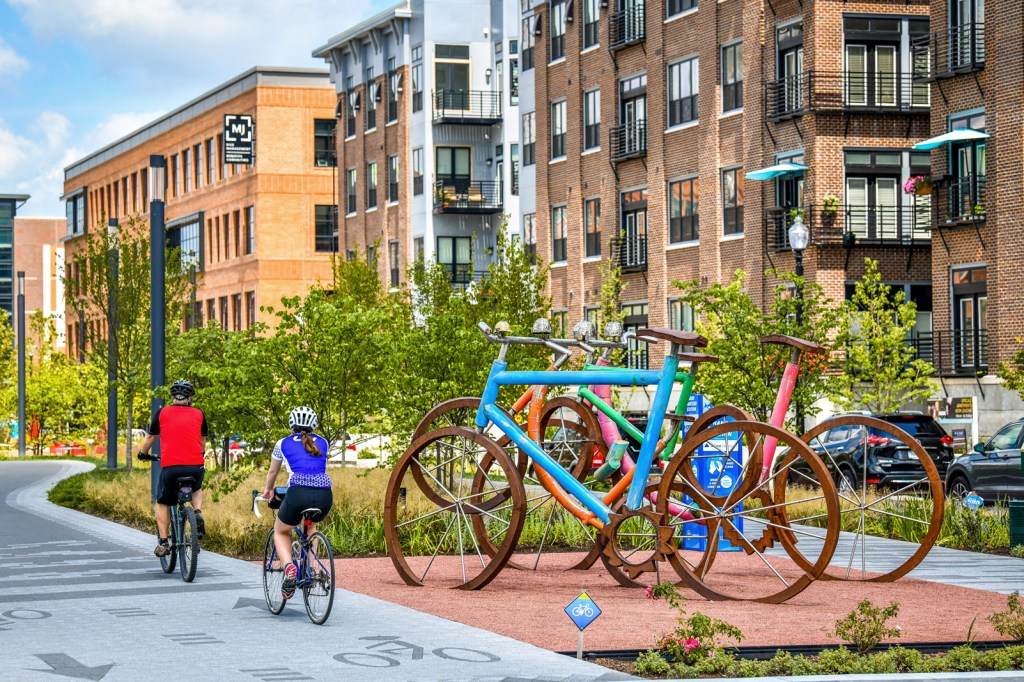
Carmel, Indiana: A Successful Example of Infill Development.
Infill development refers to the construction of new buildings and developments on previously underutilized urban land, and has been cited as critical groundwork for redesigning to be more environmentally and socially sustainable. Infill development maximizes land use efficiency, reducing land consumption and the necessity for long commutes. Underused parking lots, when transformed into affordable housing, reduces distances between residential and commercial areas. Minimizing commute times is essential in mitigating the negative impacts of urban sprawl. This is especially imperative, as cars account for more than 57% of transportation emissions in the United States [1]. Infill development also lessens the burden on infrastructure, which is increasingly necessary, as decades of insufficient funding have resulted in underserved infrastructure in many cities and towns. By making use of existing infrastructure, such as roads, utilities, and public transportation, fewer resources are required to support the same number of residents, resulting in lower energy consumption and reduced environmental impact.
The social benefits of infill development are equally compelling. As populations in urban areas grow, there is an increased demand for public services like schools, healthcare facilities, and public transportation. Infill development can support these services, making them more accessible and efficient for residents. The construction and development associated with infill projects also generate jobs within the community, providing employment opportunities and stimulating economic growth. Housing shortages can be alleviated, making cities more inclusive by providing diverse housing options, including affordable and mixed-income housing. The influx of residents may also raise property values in surrounding areas, benefitting homeowners and increasing local tax revenues, which can be reinvested in the community.
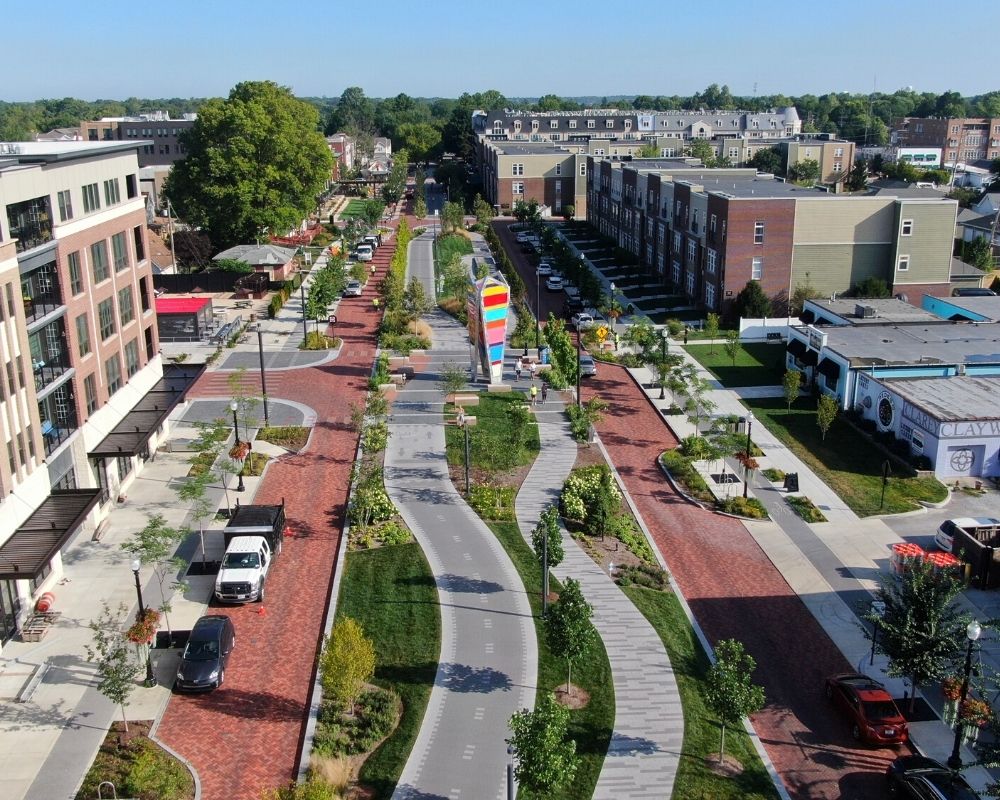
Above: Carmel, Indiana.
The benefits of infill development policies are indisputable, but implementing them would require the necessary political will to disrupt and overturn previous urban planning policies. However, because urban planning policies are set at the local level, there are legislative and policy changes that can be pursued to encourage infill development.
The first of which is rezoning land to allow for broader usage. For example, in the city of Los Angeles, single-family zoning, known as R1 zoning, is the most common zoning designation for land, comprising 38% of the city [5]. Other zoning designations include R2, which allows for two residential units per lot, and R3, which allows for multiresidential buildings and childcare facilities [6]. Furthermore, an estimated two-thirds of all residences in California are single-family homes, which accounts for 75% of developable land in the state. Upzoning, or rezoning residential areas to these higher designations, encourages the development of denser residences closer to the city center, minimizing underutilized space. Beyond rezoning, however, the underlying cause for underutilized city space, in many cases, is parking minimums that set unnecessary requirements for the amount of parking spaces that must be built. To encourage infill development, an effort must thus be made to repeal the offending urban development legislation at the local level.
To accommodate growth and remedy underlying socioeconomic divides, it is imperative that we rethink how we plan our cities. Equally apparent is that our current model for development is detrimental to the environmental and social wellbeing of our citizens. Through collective political efficacy, by acting upon local legislation, we can promote a model of infill development that bridges gaps and ensures sustainable progress in our communities.
Sources:
[1] Center for Climate and Energy Solutions
[2] Statistica
[3] Statistica
https://www.statista.com/statistics/678716/japan-carbon-dioxide-emissions-from-transport-sector/
[4] Transformative Mobility
https://transformative-mobility.org/multimedia/transport-energy-and-population-density/
[5] Los Angeles Department of City Planning
[6] Los Angeles Times

 Living Ethics Journal
Leave a comment