
By Lukas Kraft.
The negative effects of climate change and global warming are daunting and while many may flee from the challenge, we as a collective human race simply cannot. It is not a sustainable, smart, or long-term beneficial gain to ignore climate change. To meet the climate target set by the UN and the IPCC, we must act fast to limit rising temperatures to less than 1.5-2.0ºC, especially if we want to limit rising carbon emissions and their negative effects on biodiversity, aquatic life, coastal cities, and small island nations. When talking about the role of cities on climate change, UN-Habitat stated that:
“Cities are key to achieving the Paris Agreement targets. Urban areas are major contributors to climate change, accounting for about 78 percent of the world’s energy consumption and emitting more than 70 percent of global greenhouse gas emissions. However, they are also engines of climate innovation and action.”
The need for sustainable urbanization is even more urgent when considering the rapid rise in urban population, estimated to reach 68 percent by 2050. (Sharif et al.) If we assume this data to be the most accurate and up-to-date data, and I do, then does it not make sense to target cities for reducing C&GHG emissions? Not only would we be targeting the world’s leading human-caused C&GHG emissions, but it is also easier to enact municipal and local level change through locally elected officials, laws, and regulations. These local-level regulations can be more specifically tailored to the local need, are easier to pass and gain support for, and can be passed for each city individually. This allows for a more gradual and steady increase in the total climate action taking place, rather than playing a back-and-forth game with national politics and having little to no change enacted.
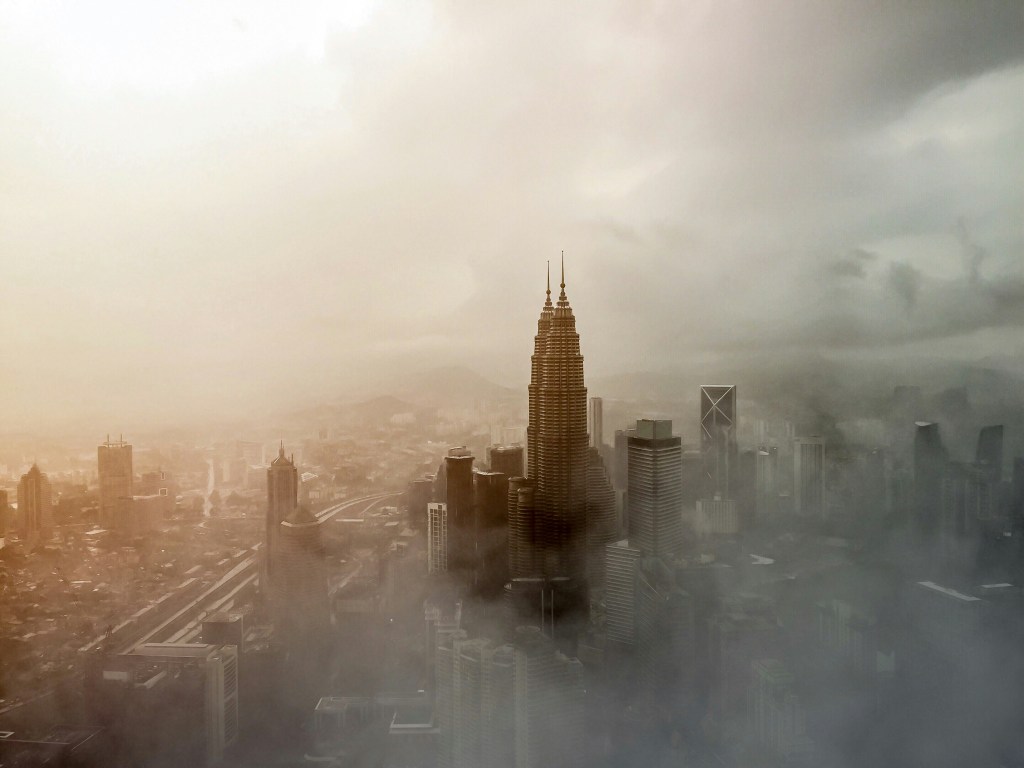
Above: Smog over Kuala Lumpur, Malaysia.
While many people tend to assume that policy change is primarily enacted on the national level, this school of thought overlooks the local and municipal level government that often makes the most change that directly affects communities for the better. For example, a national law may be passed requiring that air pollution be reduced to a certain level for all cities but because it applies to the whole nation, it lacks a clear and definitive climate action plan (CAP) that details how specific cities should go about reducing local pollution levels. If instead we took that national law and applied it on the local level, a CAP could be formulated more specifically with locally supported climate research and data that draws a clear and definitive CAP to reduce air pollution over a set period of time with exact benchmarks to hit. Not only can this create more exact and easier-to-follow plans, but it may also be more enticing for investors in climate mitigation as clear plans have been made and they can easily follow progress by measuring the action taken against the plan’s agreed-upon benchmarks.
It is thus imperative that cities invest in municipal and local level CAPs and policies. It is beneficial cost-wise and for the long-term sustainability and survivability of coastally located cities or island nations to invest in this and to encourage other mainland cities and nations to do as well. The danger for coastal cities with increasingly erratic weather patterns and rising sea levels is great and these cities should be at the forefront of climate advocacy if they wish to survive. With cities producing the majority of C&GHG emissions, local-level policy, and CAPs need to be the gold standard of environmental protection because they can be more specifically tailored to the needs of a city’s unique climate emission levels, and contributors (buildings, automobiles, construction, pollution, factories, etc.). It should be a primary priority of climate mitigation planning to focus on developing municipal-level progress.
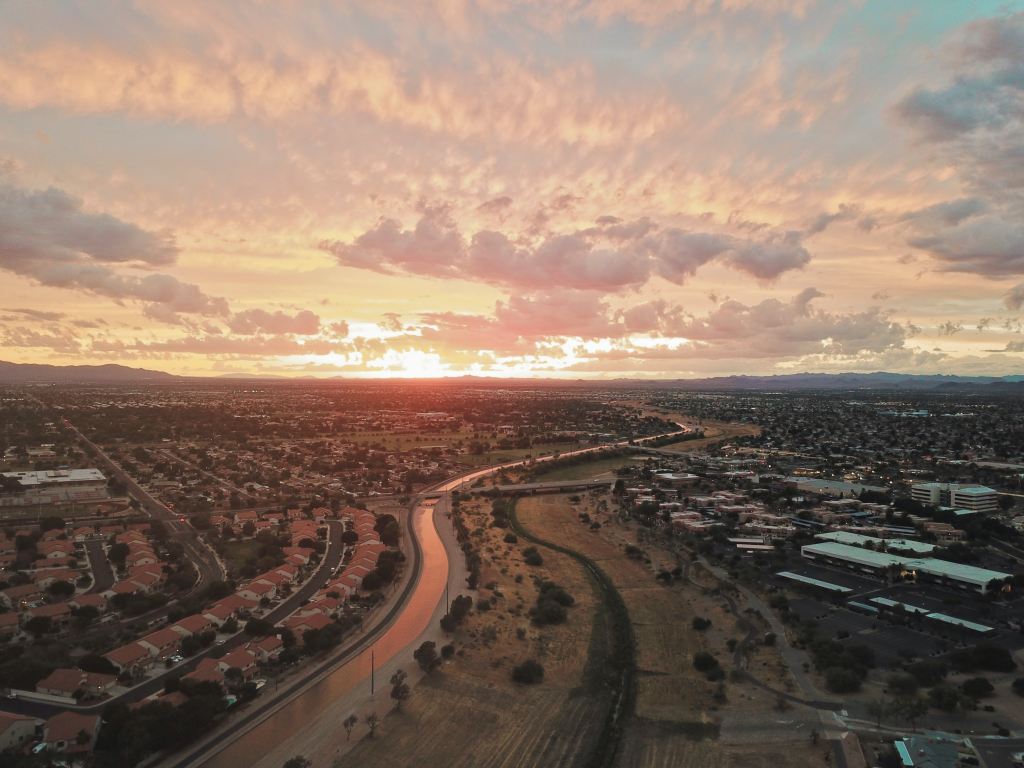
Above: Cities in the United States should tackle the unsustainable practice of urban sprawl.
With international urban population percentages projected to reach 68% by 2050, these mitigation measures would be beneficial for the local residents of all cities as erratic weather patterns can lead to worsened droughts or extreme temperatures for inland farming communities, but even more specifically for coastal cities and communities that have the most to lose from harmed ocean ecosystems that provide significant economic value to the local residents and businesses, ie coral reef’s economic tourism value. By reducing C&GHG emissions, cities can further save on costs of repair for the increasingly erratic weather patterns that can and have caused massive damage to cities. We need to be investing in the research and implementation of renewable energies that are sustainable and ecologically friendly so that we can reduce these C&GHG emissions and start to slow the increase of our global temperatures and the domino effects that follow.
While the specific path will be different for each country, and not every country will have enough support and resources to tackle climate change immediately, it is a pressing issue that all countries and cities should be aware of and actively creating committees and plans based soundly in the research of the local ecosystems and emissions to reduce future harm to the entire world and their own locals. Climate action needs to happen, and it needs to be done correctly, safely, and sustainably for future generations and our own local residents.
Works Consulted:
About the Secretariat | UNFCCC. https://unfccc.int/about-us/about-the-secretariat.
Arias, Paola A., et al. Technical Summary. https://www.ipcc.ch/report/ar6/wg1/downloads/report/IPCC_AR6_WGI_TS.pdf.
Biodiversity and Health. https://www.who.int/news-room/fact-sheets/detail/biodiversity-and-health.
Climate Change Widespread, Rapid, and Intensifying – IPCC — IPCC. https://www.ipcc.ch/2021/08/09/ar6-wg1-20210809-pr/.
“Climate Movement – Wikipedia.” Wikipedia, 12 Feb. 2023. Wikipedia, https://en.wikipedia.org/w/index.php?title=Climate_movement&oldid=1138975988.
Cutting Global Carbon Emissions: Where Do Cities Stand? 5 Jan. 2022, https://blogs.worldbank.org/sustainablecities/cutting-global-carbon-emissions-where-do-cities-stand.
Decarbonising Buildings in Cities and Regions | En | OECD. https://www.oecd.org/publications/decarbonising-buildings-in-cities-and-regions-a48ce566-en.htm.
Fecht, Sarah. “How Exactly Does Carbon Dioxide Cause Global Warming?” State of the Planet, 25 Feb. 2021, https://news.climate.columbia.edu/2021/02/25/carbon-dioxide-cause-global-warming/.
Fekete, Hanna, et al. “A Review of Successful Climate Change Mitigation Policies in Major Emitting Economies and the Potential of Global Replication.” Renewable and Sustainable Energy Reviews, vol. 137, Mar. 2021, p. 110602. ScienceDirect, https://doi.org/10.1016/j.rser.2020.110602.
“Five Reasons Why Local Government Should Influence Climate Change Plans.” The Guardian, 6 Jan. 2015. The Guardian, https://www.theguardian.com/public-leaders-network/2015/jan/06/local-government-climate-change-plans.
Gross, Samantha. “Renewables, Land Use, and Local Opposition in the United States.” Brookings, 13 Jan. 2020, https://www.brookings.edu/research/renewables-land-use-and-local-opposition-in-the-united-states/.
History of the Environmental Movement | American Archive of Public Broadcasting. https://americanarchive.org/exhibits/climate-change/history.
Mitchell, Carrie L., and Alexandra Graham. “Evidence-Based Advocacy for Municipal Climate Change Action.” Journal of Planning Education and Research, vol. 40, no. 1, Mar. 2020, pp. 31–43. SAGE Journals, https://doi.org/10.1177/0739456X17740939.
MRSC – Greenhouse Gas Reduction Strategies for Local Governments. https://mrsc.org/explore-topics/environment/sustainability/greenhouse-gas-reduction-strategies.
“Negative Effects of Sea-Level Rise.” Yo Nature, 25 June 2020, https://www.yonature.com/negative-effects-sea-level-rise/.
Neij, Lena, and Eva Heiskanen. “Municipal Climate Mitigation Policy and Policy Learning – A Review.” Journal of Cleaner Production, vol. 317, Oct. 2021, p. 128348. ScienceDirect, https://doi.org/10.1016/j.jclepro.2021.128348.
Reichstein, Markus, et al. “More Floods, Fires and Cyclones — Plan for Domino Effects on Sustainability Goals.” Nature, vol. 592, no. 7854, Apr. 2021, pp. 347–49. http://www.nature.com, https://doi.org/10.1038/d41586-021-00927-x.
Sharif, Maimunah Mohd, et al. Urban Climate Action: The Urban Content of the NDCs: Global Review 2022. United Nations Human Settlements Programme (UN-Habitat), 2022, https://unhabitat.org/sites/default/files/2022/12/ndc_urban_content_2022_report.pdf.
Technical Summary — Special Report on the Ocean and Cryosphere in a Changing Climate. https://www.ipcc.ch/srocc/chapter/technical-summary/.
US Department of Commerce, National Oceanic, and Atmospheric Administration. How Does Climate Change Affect Coral Reefs? https://oceanservice.noaa.gov/facts/coralreef-climate.html.

 Living Ethics Journal
Leave a comment