
By Vedh Ramesh.
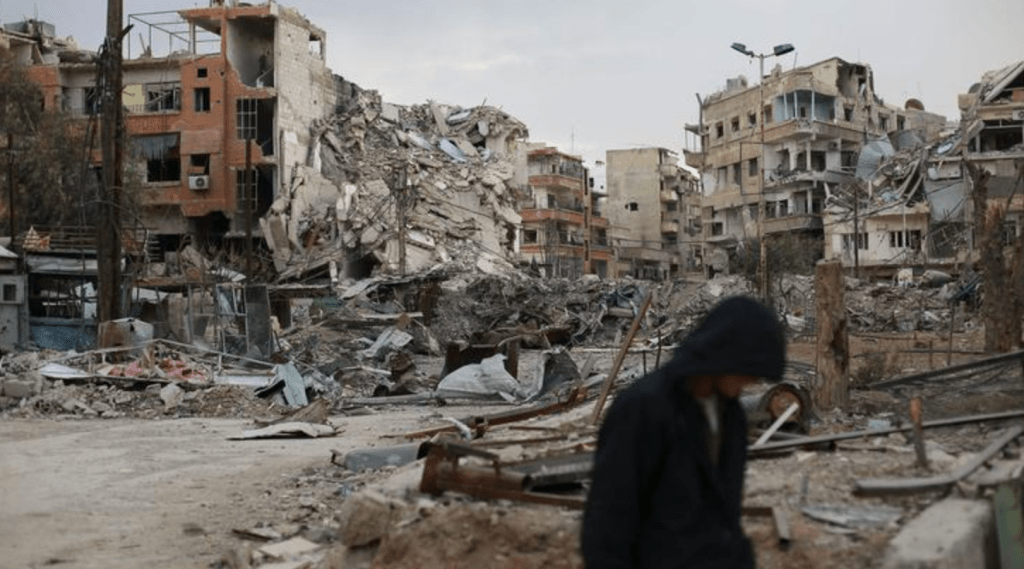
The Syrian Civil War has devastated the lives of millions of Syrian civilians. Their lives have been uprooted, their friends and family members killed, and many are left destitute, relying on food from humanitarian causes. A nation that used to be self-sufficient in terms of food production (before the war, agriculture was one of Syria’s primary economic activities, with 40 percent of Syria’s population work[ing] in agriculture or livestock”), Syria is now “dependent on food parcels brought across the border by Syrian expatriates, Gulf charities, and UN agencies such as the World Food Program”, which are now becoming “the main sources of food supplies.” The poor food situation in Syria is compounded by other factors related to the war: its economy and food supply chain has been ravaged by the war, Syria’s currency (the Syrian pound) has fallen by astounding amount (79% against the US dollar in 2022 alone), the exodus of agricultural workers in response to a civil war, and sanctions applied on Syria that further constricted Syria’s economy, restricting the ability of persons in Syria to purchase food commodities. These factors combined have had a truly cataclysmic impact on the food security of millions of Syrians — the World Food Programme reported that “11.1 million people in Syria were in need of humanitarian aid and that approximately 9.3 million were suffering from acute food insecurity.” Keeping these numbers in mind along with the fact that Syria’s population is less than 22 million, the urgency of the situation immediately becomes far more apparent. These already calamitous circumstances are further exacerbated by the fact that Syria depends on imported grain to feed its population, and much of this imported grain comes from Russia. With Russia recently being placed under heavy sanctions themselves, it has become increasingly difficult for Syria to feed its population. Food insecurity caused by the Syrian Civil War is undoubtedly one of the biggest food-related crises in existence today and warrants immediate action.
One potential approach to assist in attenuating the endemic of food insecurity in Syria due to the ongoing civil war is to find a way to counter the effects of the sanctions on Bashar al-Assad’s totalitarian regime for civilians. It is sanctions placed on him and his government by numerous Western and Arab countries that are meant to punish him and his top aides for committing numerous human rights violations that often have severe adverse effects on the Syrian economy. If the rampant inflation of the Syrian pound is halted and the economy is restored to a respectable amount of its pre-conflict amount, food will become far easier to purchase not only domestically, but also to import from foreign grain-exporting nations. In order to achieve this, one possibility is that the embargo on Syrian goods be lifted, allowing the Syrian economy to recover, while the personal sanctions against top Syrian officials be maintained, which would stay true to the original purpose of the sanctions intending to hurt al-Assad for his human rights violations. It is the trade embargo that is the source of many of the Syrian populace’s economic troubles, and if the Syrian economy improved somewhat, so would the ability to purchase and import grain to alleviate the problem of food insecurity caused by the civil war. It must be noted that some will object to this on the principle of punishing al-Assad; however the millions of suffering civilians must also be kept in mind and a delicate game of balancing sanctions must be played. Lifting the trade embargo while continuing with personal sanctions on top members of al-Assad’s regime will maintain this balance.
Another possible solution would be to send substantial amounts of food aid to assist with the crisis in the short term and infrastructure aid to assist with it in the long term. In the short term, the food aid would be used to help prevent against starvation, and in the long term, the infrastructure developmental aid would help Syria rebuild its agricultural infrastructure, thus allowing it to regain its former status as a nation which was agriculturally self-sufficient. Syria has already signed onto the PRC’s Belt and Road Initiative so they do indicate an openness to rebuilding their infrastructure. However, the Belt and Road Initiative does not deal with agricultural infrastructure, and this would emphasize the incorporation of advanced irrigation techniques so as to allow for greater crop yields in arid and semi-arid climates (like much of Syria) while simultaneously preserving a limited resource (water). Additionally, transportation infrastructure must also be developed to a lesser degree to facilitate for greater ease of transporting agricultural products, which would then make them cheaper and more easily accessible to the Syrian populace.

 Living Ethics Journal
Leave a comment