
By Vedh Ramesh.
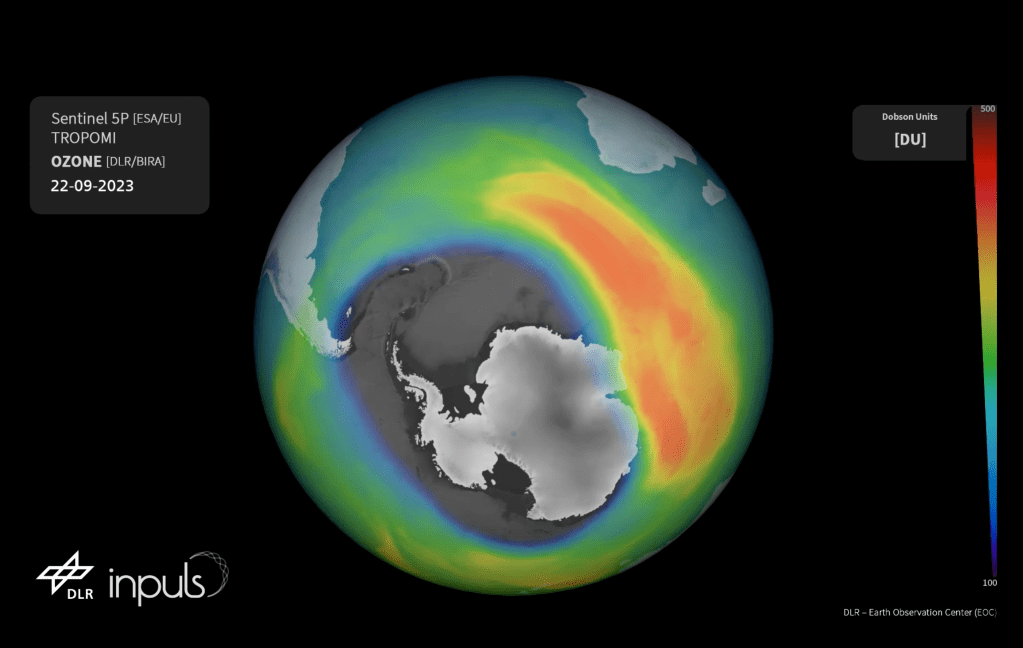
Recently, the ozone hole above Antarctica has ballooned to a near-record size. Copernicus, the ESA’s Earth observation program, found that the ozone hole has increased in size to over ten million square miles. Is this something to be worried about?[1]
As it turns out, probably no. Fluctuations in the size of the ozone hole still happen regularly due to wind patterns and temperatures changing seasonally. Mid-September to mid-October is when we usually see a peak in the size of the hole.[2] Furthermore, January 2022’s Hunga Tonga eruption increased the amount of water in the atmosphere by ~10%.[3] This may or may not have led to the increase in the size of the ozone hole, with the ESA stating that “the exact impact of the Hunga Tonga eruption on the Southern Hemisphere ozone hole is still a subject of ongoing research.”[1]
Even though the ozone hole has expanded to a near-record size, scientists expect the ozone hole to “reach its normal state again by around 2050” per Claus Zehner, the ESA’s mission manager of the Copernicus probe.[1]
[1] ESA – Ozone hole goes large again
[2] The ozone hole above Antarctica has grown to three times the size of Brazil
[3] Hunga Tonga undersea volcano eruption likely to make ozone hole larger in coming years

 Living Ethics Journal
Leave a comment